
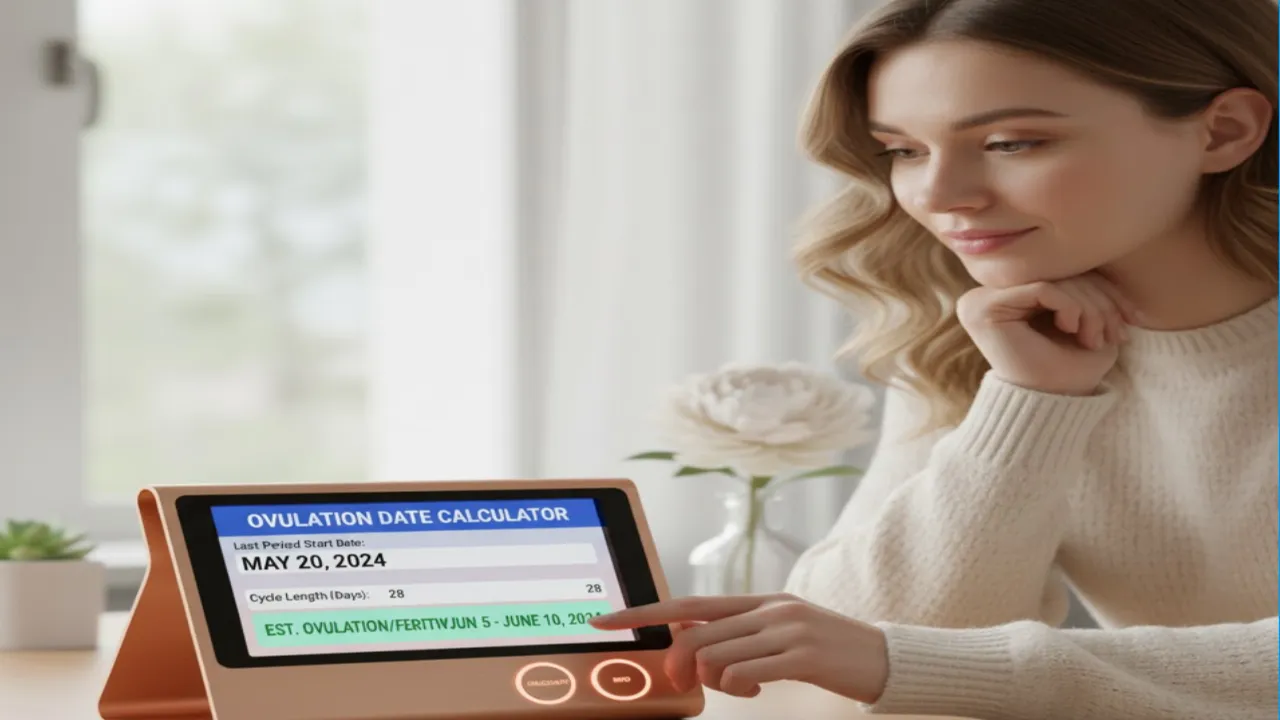
Ovulation Date Calculator
Ovulation Date Calculator, Trying to conceive can feel like navigating uncharted territory, but understanding your ovulation cycle doesn’t have to be guesswork.
Ovulation Date Calculator
Calculate your most fertile days and ovulation date based on your menstrual cycle
Your Fertility Window
The fertile window includes the 5 days before ovulation and the day of ovulation itself. This is when you’re most likely to get pregnant.
Disclaimer: This calculator provides estimates only and is not a substitute for professional medical advice. Individual cycles can vary, and many factors can affect ovulation timing.
Ovulation Date Calculator: Your Complete Guide to Predicting Fertility
Meta Description: Discover how to use an ovulation date calculator to predict your fertile window. Learn about menstrual cycles, ovulation signs, and boost your conception chances.
Ovulation Date Calculator: Your Ultimate Guide to Predicting Your Fertile Window
An ovulation date calculator transforms this journey from mysterious to manageable, giving you the power to predict your most fertile days with scientific precision. Whether you’re just starting your conception journey or have been trying for months, mastering your ovulation cycle could be the key to unlocking your pregnancy success.
In this comprehensive guide, we’ll explore everything from basic menstrual cycle biology to advanced fertility tracking techniques. You’ll discover how ovulation calculators work, why they’re remarkably accurate, and how to interpret the results to maximize your conception chances each month.
What Exactly is an Ovulation Date Calculator?
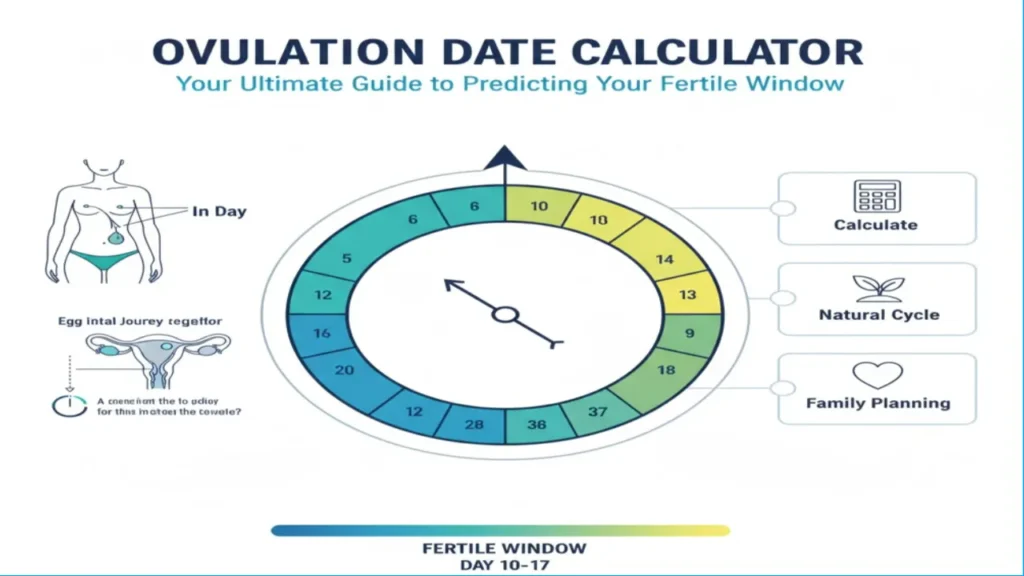
An ovulation date calculator is a sophisticated tool that predicts when you’re likely to ovulate based on key information about your menstrual cycle. By analyzing patterns in your cycle length and physiological signs, these calculators identify your fertile window—the days when conception is most probable.
The Science Behind Ovulation Prediction of Ovulation Date Calculator
Ovulation calculators operate on well-established reproductive science. During your menstrual cycle, rising estrogen levels trigger a surge in luteinizing hormone (LH), which causes your ovary to release a mature egg. This typically occurs about 14 days before your next period begins, regardless of your total cycle length. Calculators use this biological constant combined with your personal cycle data to forecast your ovulation date.
Types of Ovulation Calculators
Modern ovulation prediction comes in several formats:
- Online calculators (like the one on PregnancyCalculators.online)
- Mobile applications with cycle tracking features
- Digital ovulation predictor kits
- Temperature charting apps
- Cervical mucus monitoring systems
Each type has unique advantages, but online calculators remain the most accessible starting point for most women.
Why Accurate Ovulation Prediction Matters for Conception of Ovulation Date Calculator
Understanding your ovulation cycle isn’t just interesting biological knowledge—it’s practical information that can significantly impact your conception timeline.
The Conception Window Reality of Ovulation Date Calculator
Many couples don’t realize how narrow the fertility window actually is. An egg survives only 12-24 hours after ovulation, while sperm can live inside the female reproductive tract for up to 5 days. This creates a approximately 6-day “fertile window” each cycle—the 5 days before ovulation and the day of ovulation itself.
Having intercourse during this limited timeframe dramatically increases pregnancy chances. Research from the National Institutes of Health shows that timing intercourse within this window can improve conception rates by up to 89% compared to random timing.
Beyond Conception: Understanding Your Body
Regular ovulation tracking does more than predict fertility—it provides valuable insights into your overall reproductive health. Consistent patterns can confirm regular ovulation, while irregular results might indicate underlying conditions worth discussing with your healthcare provider.
How to Use an Ovulation Date Calculator Effectively
Getting accurate results from an ovulation calculator requires precise inputs and understanding how to interpret the outputs.
Essential Information You’ll Need of Ovulation Date Calculator
To use most ovulation calculators effectively, gather this information:
- First day of your last menstrual period: Mark your calendar when period bleeding begins, not when it ends.
- Average cycle length: Calculate this by counting days from day one of your period to day one of your next period. Track for 3-4 months for the most accurate average.
- Luteal phase length: If known, this is the number of days between ovulation and your next period. The default is typically 14 days, which applies to most women.
Step-by-Step Calculation Process of Ovulation Date Calculator
Follow these steps for the most accurate ovulation prediction:
Step 1: Record Your Cycle Data
Begin tracking your menstrual cycles for at least three months. Note the start date of each period and calculate the number of days between them. This establishes your personal baseline.
Step 2: Input Your Data Accurately
Enter the first day of your last period and your average cycle length into the calculator. Be precise—even a two-day error can shift your fertility window prediction.
Step 3: Interpret Your Results
The calculator will typically provide:
- Your next expected period date
- Your predicted ovulation date
- Your full fertile window (including several days before ovulation)
Step 4: Confirm with Physical Signs
Use physical ovulation symptoms to verify calculator predictions. These include:
- Changes in cervical mucus (becoming clear, stretchy, like egg whites)
- Mild pelvic pain or twinges (mittelschmerz)
- Small rise in basal body temperature
- Breast tenderness
- Increased libido
Understanding Your Menstrual Cycle Phases
To truly master ovulation prediction, it helps to understand what’s happening throughout your entire menstrual cycle.
The Follicular Phase (Pre-Ovulation)
This phase begins on day one of your period and continues until ovulation. During this time:
- The pituitary gland releases Follicle Stimulating Hormone (FSH)
- Ovarian follicles begin maturing
- Estrogen levels gradually rise
- Uterine lining thickens in preparation for potential pregnancy
The length of this phase varies significantly among women and even from cycle to cycle, which is why ovulation calculators need your specific cycle data.
Ovulation Phase of Ovulation Date Calculator
This is the main event—the release of a mature egg from its follicle. Key characteristics:
- Triggered by a surge in Luteinizing Hormone (LH)
- Typically occurs about 14 days before your next period
- The egg travels down the fallopian tube awaiting fertilization
- Highest probability of conception during this time
Luteal Phase (Post-Ovulation)
After ovulation, the ruptured follicle transforms into the corpus luteum, which:
- Secretes progesterone to support a potential pregnancy
- Maintains the uterine lining
- Typically lasts 12-16 days (usually 14)
- Ends with either pregnancy or menstruation
Unlike the follicular phase, the luteal phase remains relatively consistent in length for each woman.
Advanced Ovulation Tracking Methods of Ovulation Date Calculator
While ovulation calculators provide excellent predictions, combining them with physical tracking methods creates the most comprehensive fertility picture.
Basal Body Temperature (BBT) Charting
This method involves:
- Taking your temperature immediately upon waking, before any activity
- Using a special basal thermometer for precision
- Noting a sustained temperature rise of 0.5-1°F after ovulation
- Tracking patterns over several cycles
While BBT confirms ovulation has occurred, it doesn’t predict it in advance, making it ideal to use alongside calculators.
Cervical Mucus Monitoring
Your cervical mucus changes throughout your cycle in predictable patterns:
- After menstruation: Little to no mucus, or sticky/tacky texture
- Approaching ovulation: Increased quantity, creamy or lotion-like
- Peak fertility: Clear, stretchy, slippery (like raw egg whites), allowing sperm survival and transport
- After ovulation: Quickly returns to thicker, cloudier consistency
Ovulation Predictor Kits (OPKs)
These at-home test strips:
- Detect the luteinizing hormone (LH) surge that precedes ovulation by 24-36 hours
- Provide a clear positive or negative result
- Work best when started several days before your predicted ovulation date
OPKs are particularly useful for women with irregular cycles where calculators alone may be less accurate.
Factors That Can Affect Ovulation Timing
Even with perfect tracking, various factors can influence when you ovulate, making combination tracking approaches most reliable.
Lifestyle Influences on Ovulation
- Stress: High cortisol levels can delay or inhibit ovulation
- Significant weight changes: Both underweight and overweight can disrupt cycles
- Exercise intensity: Strenuous training may affect hormonal balance
- Sleep patterns: Irregular sleep can impact hormone regulation
- Travel: Time zone changes and disruption to routines
Medical Conditions Impacting Ovulation
- Polycystic Ovary Syndrome (PCOS)
- Thyroid disorders
- Hyperprolactinemia
- Primary ovarian insufficiency
- Endometriosis
If you suspect an underlying condition, consult a healthcare provider for proper diagnosis and treatment.
Common Ovulation Calculator Mistakes to Avoid
Maximize your calculator’s accuracy by avoiding these frequent errors:
Inaccurate Cycle Length Estimation of Ovulation Date Calculator
- Mistake: Guessing your cycle length instead of tracking it
- Solution: Use a period tracking app or calendar for at least three cycles
Misidentifying Cycle Day One of Ovulation Date Calculator
- Mistake: Counting from when bleeding ends or from light spotting
- Solution: Mark day one as the first day of full menstrual flow
Assuming 14-Day Luteal Phase
- Mistake: Always using 14 days without confirming your personal pattern
- Solution: Track ovulation symptoms or use BBT to determine your actual luteal phase length
Overlooking Physical Signs
- Mistake: Relying solely on calculator predictions
- Solution: Use calculators as a guide while watching for physical ovulation indicators
Optimizing Conception Using Your Ovulation Results
Knowing your fertile window is powerful, but using that information strategically can further enhance your conception chances.
Timing Intercourse for Maximum Effectiveness
- Begin having intercourse every other day once your fertile window opens
- Include the day of predicted ovulation and the two days preceding it
- Continue through the day after expected ovulation
- Remember that daily intercourse may reduce sperm count in some men
Supporting Reproductive Health from Ovulation Date Calculator
While timing matters, overall health significantly impacts fertility:
- Maintain a healthy BMI (Body Mass Index)
- Take prenatal vitamins with folic acid
- Limit alcohol and caffeine consumption
- Avoid smoking and recreational drugs
- Manage chronic health conditions
When to Seek Additional Help
Ovulation calculators are excellent tools, but sometimes professional guidance becomes necessary.
H3: Red Flags Worth Discussing with Your Doctor
- Irregular cycles (varying by more than 7-9 days)
- No period for 90 days or more
- Consistently painful periods
- Under 35 and trying to conceive for 12+ months without success
- Over 35 and trying for 6+ months
- Known reproductive conditions like PCOS or endometriosis
Fertility Specialist Referral Indicators
- Failed ovulation despite regular cycles
- Suspected tubal blockages
- Male factor infertility concerns
- Recurrent pregnancy loss
- Advanced maternal age (over 40)
Modern fertility treatments offer numerous options, from medication to assisted reproductive technologies.
Frequently Asked Questions About Ovulation Date Calculator
How Accurate Are Online Ovulation Calculators?
Online ovulation calculators are generally quite accurate for women with regular cycles, typically predicting ovulation within 1-3 days of when it actually occurs. Accuracy increases when you input data from several previous cycles rather than relying on estimates. For the most precise results, combine calculator predictions with physical signs like cervical mucus changes or ovulation test kits.
Can I Use an Ovulation Calculator if My Cycles Are Irregular?
Yes, but with adjusted expectations. With irregular cycles, calculators provide estimates rather than precise predictions. In this case, focus on identifying your personal ovulation signs rather than relying solely on calendar-based predictions. You may need to track for a longer period to identify patterns, and consider using ovulation predictor kits which detect hormonal changes directly.
What’s the Difference Between an Ovulation Calculator and an Ovulation Test Kit?
Ovulation calculators predict based on historical cycle data and averages, while ovulation test kits detect the actual luteinizing hormone (LH) surge that precedes ovulation by 24-36 hours. Calculators are free and provide advance notice of your fertile window, while test kits offer more precise timing but must be used during your predicted fertile window to catch the surge. Many women use both for optimal results.
How Soon After Ovulation Can I Take a Pregnancy Test?
Wait until at least 10-14 days after ovulation for the most accurate results. Testing too early can produce false negatives because implantation may not have occurred yet, or hCG levels might be too low to detect. For the most reliable results, wait until the day of your expected period or later, and use a sensitive early detection test if testing before your missed period.
Can Stress Really Delay Ovulation?
Absolutely. High stress levels increase cortisol production, which can interfere with the hormones that trigger ovulation. This can result in delayed ovulation, making your cycle longer than usual, or in severe cases, prevent ovulation entirely (anovulation). Stress management techniques like meditation, yoga, adequate sleep, and moderate exercise can help maintain regular ovulation patterns.
Do Ovulation Calculators Work for Women with PCOS?
Ovulation calculators are less reliable for women with PCOS since cycles are often irregular or anovulatory. Women with PCOS may experience multiple follicular developments without ovulation or have extended cycles with unpredictable ovulation timing. In these cases, symptom tracking, ovulation predictor kits, and monitoring through ultrasound or blood tests with a healthcare provider are more reliable methods.
Conclusion: Empowering Your Conception Journey with Knowledge
Understanding your ovulation cycle transforms the conception journey from mysterious to manageable. An ovulation date calculator serves as your personal fertility guide, illuminating your most fertile days each month and dramatically increasing your chances of pregnancy. By combining calculator predictions with physical signs and modern tracking methods, you gain unprecedented insight into your reproductive patterns.
Remember that while tools provide valuable data, every woman’s body is unique. What works perfectly for one person might need adjustment for another. Be patient with the process, celebrate small understanding gained, and trust that each cycle brings new information toward your goal.
Ready to take control of your fertility journey? Use our accurate ovulation date calculator at PregnancyCalculators.online to discover your personal fertility window. Share your experiences or questions in the comments below—we’re here to support your path to parenthood every step of the way.
| # 🌟 Summary Pregnancy Calculators tools | |
| Category | Purpose |
| Pregnancy Calculators | Track pregnancy weeks, months, and milestones |
| Due Date & Delivery Calculators | Estimate EDD and delivery timelines |
| Conception & Gestation Calculators | Find conception and gestational age |
| Ovulation & Fertility Calculators | Identify fertile windows and ovulation dates |
| Menstrual & Period Calculators | Predict and track menstrual cycles |
| Safe Days & Fertility Protection | Calculate non-fertile (safe) days |
| Implantation & Pregnancy Testing Tools | Estimate implantation and test accuracy |
| Hostinger Web hosting | |
